This piece looks at what the ASEAN Agreement on Transboundary Haze Pollution requires and what could change before ASEAN Leaders meet in Manila for their regular summit from 16 to 18 November 2026. At its centre is Indonesia’s consent to specific, advance help, so no one has to ask in public when the smoke is at its worst.
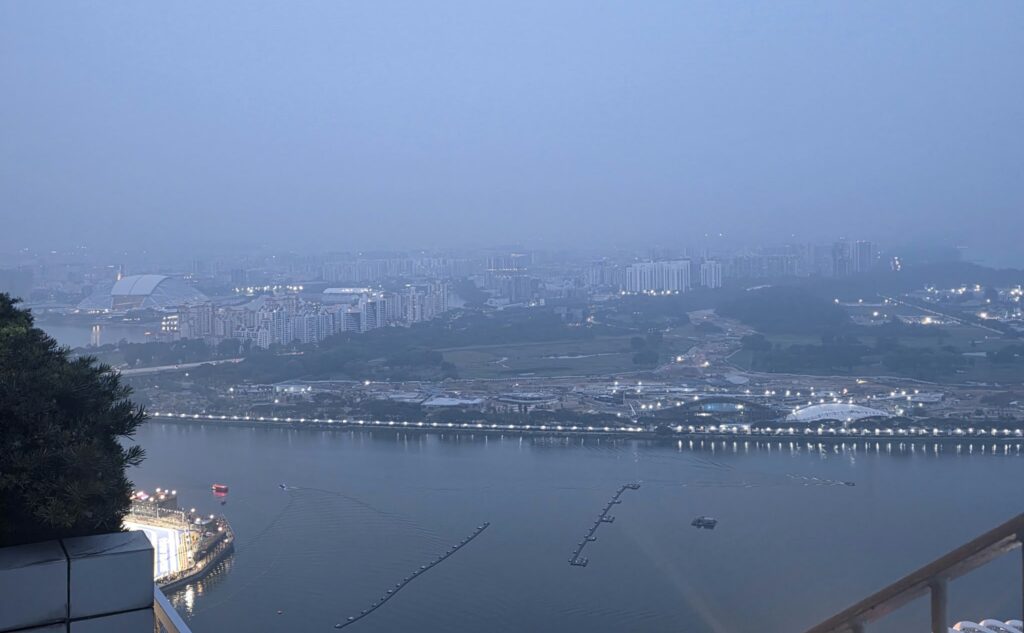
In the second week of October, readings in parts of Central Kalimantan far exceeded the 300-mark that air quality indices consider hazardous. Singapore’s 24-hour Pollutant Standards Index (PSI) reached 192 on 9 October 2026, and Malaysia’s Johor state closed all its schools on 8 and 9 October 2026. By 21 September, Indonesia’s health ministry had recorded more than 170,000 acute respiratory infections in the haze-affected provinces.
None of it was unforeseen. The Singapore Institute of International Affairs (SIIA) gave 2026 a “Red” risk rating for severe haze on 24 June 2026, only the second time since 2019. ASEAN’s alert system reached Level 3, its highest, on 26 August 2026, and the US National Oceanic and Atmospheric Administration (NOAA) now estimates an 83% chance of an El Niño of historic strength between October and December.
The warning worked. What has moved more slowly is the help. ASEAN’s haze agreement allows a country in difficulty to accept assistance but never obliges it to do so, and the gap between an offer and aircraft in the air has again been measured in weeks.
Where the treaty stops
The ASEAN Agreement on Transboundary Haze Pollution entered into force in 2003 and rests on one principle: the host fights its own fires first. Article 5(2) provides that the ASEAN Coordinating Centre for Transboundary Haze Pollution Control (Centre) works “on the basis that the national authority will act first to put out the fires.” Article 12(2) allows assistance only “at the request of and with the consent of the requesting Party,” or, if offered, with the consent of the receiving Party. This reflects the sovereignty and non-interference language in the ASEAN Charter preamble.
The treaty also asks for one modest thing that most commentary passes over. Under Article 12(4), a Party to which help is offered “shall promptly decide and notify” the offeror whether it can accept and on what scope and terms. The decision rests with Indonesia. The treaty asks only for a prompt reply.
Recent developments illustrate the difficulty. In September 2026, Malaysia offered three helicopters, an aircraft and 52 personnel, and Indonesia’s President Prabowo Subianto welcomed the offer. On 7 October 2026, Malaysia’s Foreign Minister, Mohamad Hasan, said Prabowo had accepted, though the location and method of deployment were still under discussion. After a cabinet meeting on 12 October 2026, Indonesia’s Coordinating Minister for Political and Security Affairs, Dudung Abdurachman, said offers of international help had not been discussed and that Indonesia remained capable of handling the fires for now. An agreement in principle exists, but the scope and terms, as addressed in Article 12(4), still need to be settled. The pattern is an old one. In 2015, Indonesia’s then Environment and Forestry Minister, Siti Nurbaya Bakar, said of a Singaporean offer, “One more water-bombing unit from Singapore would not make much difference.” The Singapore Armed Forces concluded their firefighting operations on 24 October 2015, weeks after the smoke.
What can be done now
Two steps do not require new decisions by Leaders. Jakarta can settle the scope and terms in writing with Malaysia and Singapore, specifying what it accepts, where and under whose command, since Article 13 leaves the host in overall control. The environment ministers can also meet.
Hasan said on 12 October 2026 that he would raise the haze issue with his ASEAN counterparts before the Summit, noting that ASEAN’s disaster mechanisms do not cover it. Article 18(2) allows extraordinary meetings of the Conference of the Parties “upon the request of one Party, provided that such request is supported by at least one other Party.”
What the proposals miss
Recent commentary has converged. Dr Chai Ming Hock of Universiti Sains Malaysia, writing in Weekly-Echo on 23 September, called for agreed health-risk thresholds to trigger regional action. Dr Low Kah Choon of Universiti Utara Malaysia, writing in Malay Mail on 16 September, proposed moving firefighting resources forward when hotspots, peat dryness and wind cross agreed thresholds. Melinda Martinus, a fellow at the ISEAS Yusof Ishak Institute in Singapore, wrote in CNA that ASEAN must agree “in advance how information, equipment and personnel can be shared and deployed across borders.”
These proposals have merit, but they encounter the same obstacle. A trigger can automatically produce data and an offer. It cannot produce consent, which Article 12(2) leaves to the affected state. Reclassifying haze as a disaster would not change that, since the ASEAN Agreement on Disaster Management and Emergency Response likewise allows assistance only “at the request, and with the consent, of the Requesting Party” (Article 11(2)). Martinus’s agreement in advance comes closest. It lacks a legal vehicle and a payment mechanism.
Consent before crisis
Decide during the wet season which help Indonesia will accept in the dry season, on whose terms and at whose cost, so that at Level 3 nobody has to ask, and nobody has to be seen to be accepting it.
The treaty already sets out the framework. Article 12(6) requires each Party, within its capabilities, to notify the Centre of the experts and equipment it could make available and on what terms. Article 13 keeps the host in command, and Articles 14 and 15 provide customs exemptions and transit. In 2015, ministers revised the operating procedure under Article 10(2) and agreed to “institutionalise the possible activation of international assistance”.
I think the task is to replace “possible” with “pre-agreed.” At Level 3, packages Indonesia has approved in advance, such as ground firefighting teams first, then water-bombing flights over named provinces when conditions allow, would deploy on the Centre’s call, under Indonesian command, and be funded by a regional fund. Indonesia chooses the categories and provinces and can narrow them at any time. Article 12(2) remains intact because Indonesia retains consent. It is given early, when the decision can be taken calmly. The treaty does not expressly create standing consent, but Article 12 says nothing that prevents a Party from giving conditional consent in advance. Tying the trigger to Regional Alert Level 3 rather than to a national declaration also avoids a question the treaty leaves open: whether a domestic national disaster, which Indonesia said on 12 October 2026 it will not declare for now, is the “emergency situation” of Article 5(2).
Operating procedures do not require six months’ notice, unlike protocols and amendments, so ASEAN can adopt them at the 21st Conference of the Parties (COP-21) to the ASEAN Agreement on Transboundary Haze Pollution in Da Nang, tentatively scheduled for October. Under Article 9(1)(g) of the Centre’s own agreement, its committee proposes the procedures for requesting the mobilisation of the Fund so that the funding route can be incorporated into the same rules.
Five signatures away
Advance consent requires an institution to coordinate deployment, which is why the Centre’s delay matters. Its agreement was signed on 27 May 2025. In July 2026, ASEAN thanked Vietnam for its instrument of approval and noted that the steering committee members were still in their domestic processes. Under Article 25 of the agreement, it enters into force sixty days after the sixth instrument is deposited with the ASEAN Secretary-General. If Vietnam’s has been deposited, as ASEAN’s statement implies, five more from Brunei, Indonesia, Malaysia, Singapore and Thailand would make six. If deposited by 31 December 2026, they would bring the Centre into force on 1 March 2027, three months before the dry season. If they wait for ASEAN’s 60th anniversary on 8 August 2027, it would be October. As host, Indonesia is well placed to lead: its environment minister at the time, Hanif Faisol Nurofiq, said in April that it was preparing a presidential regulation on ratification.
Transparency must work both ways
Faster assistance addresses the immediate crisis; preventing the next one also requires clearer accountability. Dr Low asks why no one moves first. Perhaps no one has to. In 2013, Leaders approved a haze monitoring system under which digitised concession maps of fire-prone areas are shared among governments. Public disclosure is the natural next step, and Article 4(2) already obliges a source state to “respond promptly” to an affected neighbour’s request for relevant information.
A simultaneous exchange would ease acceptance. Indonesia would publish, as its investigations allow, the owner and status of each concession it has sealed, with 68 companies’ concessions by the end of September 2026, according to the Straits Times. Malaysia and Singapore would publish, for each home-based company that appears in the data, who owns it and what the regulator has done. Greenpeace Indonesia and Greenpeace Malaysia, with the peatland watchdog Pantau Gambut, list a Malaysian plantation group and several Singapore-linked business interests among 20 entities they link to fire sources, an association, not a finding of liability. Disclosure on both sides turns an accusation into a procedure.
The Manila opportunity
The Charter gives Leaders more latitude than the treaty. Article 7(2)(d) authorises the Summit to “address emergency situations affecting ASEAN by taking appropriate actions,” and Article 7(2)(c) provides for ad hoc ministerial meetings on cross-cutting issues. A short Leaders’ Decision could convene environment, defence and agriculture ministers by the end of January, call for the five deposits by 31 December, and ask COP-21 to adopt advance consent. Articles 20(1) and 20(3) set the limit: ASEAN decides by consultation and consensus, and the treaty retains its own decision rules. The decision would set a political direction, not amend the treaty, and every member, including Indonesia, must be able to join. The Philippines, as Chair, has confirmed that tackling haze is in the agenda when Reuters asked on 12 October 2026. Singapore assumes the Chair on 1 January 2027, and Article 32(c) obliges the Chair to ensure “an effective and timely response to urgent issues or crisis situations affecting ASEAN, including providing its good offices.”
Indonesia’s progress and constraints
None of this removes the work at home. Greenpeace and Pantau Gambut place 2,951 of the 5,540 smoke-source points they mapped between 8 August and 20 September within peat hydrological units, or 53%. After the 2015 fires, President Joko Widodo established a peatland restoration agency in 2016 and, in 2019, made a permanent moratorium on new permits in primary forest and peatland. Fires still recur, with about 1.6 million hectares burned in 2019 and 1.16 million in 2023. After Prabowo met with a group of experts on 24 September, the forestry minister announced a new peatland and mangrove agency that reports directly to the president. The Straits Times reports that by the end of September 2026, Indonesian authorities had named 138 suspects. Malaysia’s Prime Minister, Anwar Ibrahim, said on 8 October 2026 that Prabowo had agreed to take the necessary steps, and The Star reported on 13 October 2026 that Prabowo had ordered tougher action.
A request made in public, at the height of the smoke, is hard for any government to accept. Consent given early, from Indonesia’s own menu and under its own command, asks for none of that. Singapore also has its own haze Act, which the Straits Times says has been triggered more than once, so transparency has to run both ways.
The lesson of 2026
ASEAN’s warning system works: the Red rating, the sub-regional transboundary haze pollution ministerial steering committee briefing in Bali and Level 3 all arrived in time. Assistance remains constrained by the treaty’s consent rule. The solution lies in how consent is given, not in overriding it. The pending commitments have no dates: the Centre has been in view since 2015 and remains not in force. The 2013 decision to share concession maps has not yet been matched by public disclosure.
ASEAN was not designed for speed, and in most years its pace is part of how it holds 10, now 11, members together. In a haze year, that pace is measured in lungfuls and school days. Manila is the next test, and the next dry season begins in June. The aim is for the yes to arrive before the smoke does.
Pushpanathan Sundram is a leading expert in public policy, ASEAN affairs and emerging non-traditional security issues, with almost four decades of experience across the public, international and private sectors. He advises StoneBench on projects related to Asia’s political, economic and regulatory landscapes. Formerly the Deputy Secretary General (Deputy Minister) for the ASEAN Economic Community (AEC), Nathan is the CEO of PublicPolicyAsia Advisors, a premier business advisory and government affairs consulting firm headquartered in Singapore.
He is a visiting fellow at the School of Public Policy at Chiang Mai University in Thailand, where he bridges academia with practice. His most recent book is called Transformative ASEAN: An Insider’s Reflections, published in December 2024. He holds a PhD in Public Policy.