
How is the shift from a unipolar to multipolar world impacting business?
The first part of this interview looked at the emergence of what some are calling an “India-China-Russia economic alliance”, which itself is a reflection of growing discontent with US policy, and efforts by countries to forge their own paths.
In this second part, we look at the implications of the shift from a unipolar to a multipolar world for businesses, and on US-China relations. Andrew Cainey explains the rise of nations like China and India in a multipolar landscape where power is more distributed. He then goes on to talk about how businesses can navigate this new environment. Interestingly, he talks about mutual dependencies between the US and China.
StoneBench: How can businesses prepare for the ongoing shift from a unipolar to a multipolar world?
Andrew Cainey: Businesses need to understand what to prepare for—and then act. ‘Multipolar’ is a popular term, but also quite ambiguous. What does it really mean for multinationals? Are we seeing the rise of the ‘multipolar multinational’ and what would that look like?
These questions take us away from strictly commercial matters to issues of national ambition, power projection and how countries position themselves. Traditionally in international relations, polarity describes the distribution of power between countries across security, economics and diplomacy. It’s about how and why countries and their leaders act on the world stage; about how they seek to shape and influence beyond their borders; about how they persuade, encourage, coerce and change the behaviours of others. This has been going on throughout history—talk of a ‘unipolar moment’ after the end of the Soviet Union where effectively only the US ‘mattered’ was always an abstraction. But the world has indeed changed a lot since then.
Alongside sustained growth in lower-income economies, we have seen what I call the “End of Convergence”. In other words, the end of the assumption—mainly but not only in the West—that countries are converging on a shared approach to economic development (rooted in market liberalisation) and to governance (based on democratic norms domestically and acceding to existing, shared rules globally).
We’ve seen the rise of China, India and others in terms of economic heft, technological progress, cultural impact and alternative approaches to governance at home and abroad. ‘Multipolar’ is clearly a better description of where things stand. Power is more distributed, with a patchwork of different countries advancing and seeking to implement their own perspectives on how to run things. This world is a messier, more uncertain one.
As long as national power projection and business decisions were separate domains, this all had limited relevance for companies. But governments now intervene in the economy more actively than a decade ago. This shapes the business environment. Governments increasingly apply the lens of national security to what were previously just economic decisions. And there is renewed interest in activist industrial policy, prompted largely by China’s successes. So companies are now very much affected. They need to work with a wide range of different rules, standards, approaches. It’s a world of constraints and controls but also of subsidies and government support.
StoneBench: How are businesses responding to these new realities?
Mr Cainey: Much of this is familiar to multinationals, long used to operating in diverse economies and cultures. It is the scale and intensity that has increased, We might call this the ‘multi’ part of multipolar. Many countries are now significant players in the world economy as producers, as customers and—increasingly—as innovators and investors. Each is different in its own way—how its economy operates, how society is evolving, what customers want, what role the government plays and what role companies are expected to play within all this. China is different from India and India different from Saudi Arabia. And each is different from the US or Germany.
Understanding and working with these substantial differences will be more critical in the future. The countries of the Global South offer high growth potential. Even at its current slower growth rate, China represents the largest source of incremental GDP growth in the world. New, capable, high-growth competitors are emerging from these countries, expanding internationally. Companies need to focus even more on local differences, local stakeholders and doing what it takes to win on the ground—China for China, US for US.
Dealing with the ‘polar’ in multipolar is less familiar territory for many. In a multipolar world, companies don’t just have to adapt locally to compete in many different contexts.
Multinationals are and need to remain more than the sum of their individual country operations. If not, they need to break themselves up into national businesses.
To thrive as multinationals, companies must now navigate complementarities and tensions between different governments. This means working with a changing patchwork of agreements on topics such as cross-border data flows and the rules of origin in tariff schedules. It means being ready for sudden vibe shifts in bilateral relations or policy measures that affect companies based on where their headquarters are. Companies need to know which regulations, trade terms, controls and standards hold sway where. They must position themselves as best they can; ensure they are in compliance with applicable policies; and yet have the agility and flexibility to respond rapidly when elements inevitably change.
One useful analogy for a multipolar world is that of magnetic poles. When put close to one another, magnets attract or repel—or, if too weak, have no meaningful impact beyond themselves. Mutual attraction provides the basis for more supportive trading and investment relations—be they the West’s ‘like-minded countries’ contemplating de-risking from China or the growing number of BRICS countries. With opposing poles (the US and China as the stand-out example), companies need to judge where contradictions can be managed and where they become untenable. However, unlike magnetic poles, how these geopolitical poles interact is not fixed. Government policy choices make a difference. For the most part, things are manageable. While US-India business sentiment has deteriorated recently and some India-China tensions have eased, business continues. But some combinations simply don’t work—a company cannot do business in the US and in Iran. What works can change suddenly: Western multinationals had to leave Russia after the invasion of Ukraine.
Beyond policy choices, multipolar also means multiple standpoints, multiple information environments, multiple perspectives. Depending on where in the world you are, the same action taken by the US, China or the EU can look very different. Business decisions need to account for this. And different sectors will have different important ‘poles’. In music and movies, South Korea has greater reach beyond its borders than does China. It is truly an attracting pole in culture and soft power. The Korean government is keen and active to keep it that way.
StoneBench: Do you see countries like the UK pivoting closer to Asia? And why?
Mr Cainey: Increased attention to and engagement with Asia is inevitable from the UK and other European countries—even though digitisation has not abolished physical distance. The headline numbers for Asia’s importance have not changed: just under 40% of the world economy, 60% of the world’s population and around the same share of global growth. And with that has come increasing innovation in many domains. Over time this will also mean a critical role in standards-setting. And we are seeing a greater willingness in Asia to take the initiative in international agreements such as the RCEP and CPTPP trade agreements.
Indeed, the UK announced its ‘tilt to the Indo-Pacific’ in its 2021 Integrated Review of British foreign policy—effectively a ‘pivot to Asia’, to use Obama’s phrase. Somewhat strangely, the 2023 Refresh of this Review declared the tilt to be substantially complete. This makes sense in terms of the structures through which the UK engages in Asia—for example, as an ASEAN Dialogue Partner, a member of the CPTPP trade agreement and various security-related initiatives such as the GCP Programme and AUKUS. But it is too static a description. Asia will only grow in importance to the UK. And while ‘Indo-Pacific’ as a term has its rhetorical uses, it’s so much simpler to just say “Asia”. This acknowledges too the critical role of China—within Asia and for the UK and the rest of Europe. In the past year, the UK has re-engaged with China at senior political levels, while signing a Free Trade Agreement with India and building closer relations with Japan, South Korea and ASEAN.
StoneBench: How do you see the tariff/ tech confrontation between the US and China play out, given China’s near-monopoly over processing and refining rare earth minerals?
The past few months have been a telling example—on the US side—of the difference between knowing something intellectually and living it viscerally.
Mr Cainey: China’s dominant position in rare earths and processing has long been well-known. Rare earths hit the headlines briefly in 2010 with reports of Chinese supply restrictions to Japan. But action to diversify away from China has been slow in the US and Europe. Now the US has truly felt what it means to be dependent on China for rare earths and rare earth magnets. China felt a similar visceral reaction when the US sanctioned Huawei and ZTE in 2018.
So I’d say there’s now more of a balance in understanding true mutual dependencies. That makes the US more cautious. It will also spur action—hopefully sustained—to address these dependencies on the US side. We’ve seen some initial moves on rare earths: the US government investment in and partnership with MP Materials is striking. But it is a long road ahead to develop capabilities and scale that and even start to approach China’s position. The continuing interdependence means the promise of a generally more stable US-China relationship. It also means continued significant trading relations that stay clear of punitive tariff levels and far-reaching export bans. There will though be occasional squalls, or worse, as each side continues to assert its interests; signal to its domestic political audiences; or simply misjudges the situation.
And none of this removes the inherent competitiveness and security concerns on both sides. Diversification, de-risking or decoupling—call it what you will—will continue in advanced technologies of all kinds, in data and AI, and critical dual-use materials. The tussle over advanced semiconductors is a good illustration. On the surface we’ve gone in a couple of years from US placing export controls on the most advanced Nvidia chips to China announcing a ban on the export-compliant chips that Nvidia has developed for the Chinese market. Beneath the public messaging on all sides and negotiation, Chinese companies continue to advance their own capabilities with work-arounds and different technology solutions. All the same, in parallel to all this, many American multinationals continue to have strong, profitable businesses in China and American consumers choose China’s Shein, Temu and TikTok at home.
StoneBench: Where do you see the US-China relationship in the near-term?
Mr Cainey: Within these broad outlines, there is still a lot of policy uncertainty. The near-term priority seems to be smoothing a path for successful Trump-Xi meetings, first at APEC in Seoul and thereafter in China and the US. But this could all still go in a very different, more antagonistic direction. This is more easily seen on the US side where policy debates are more transparent, but is no doubt true in China too. While President Trump speaks positively of his relations with President Xi and welcoming 600,000 Chinese students to the US, most senior members in his administration are inclined to be more hawkish and confrontational with China. Taiwan scenarios continue to feature heavily in discussions on all sides.
So there remains room for sudden shifts in policy choices and in the bilateral relationship overall. As British Prime Minister Macmillan once said, ‘events, dear boy, events’ are often what matters most. There are many potential triggers for changes in the relationship. However, the realities of mutual interdependence should put a floor under such shifts in the next few years at least, and provide the opportunity to figure out more durable policies.
The first part of this interview can be read here.
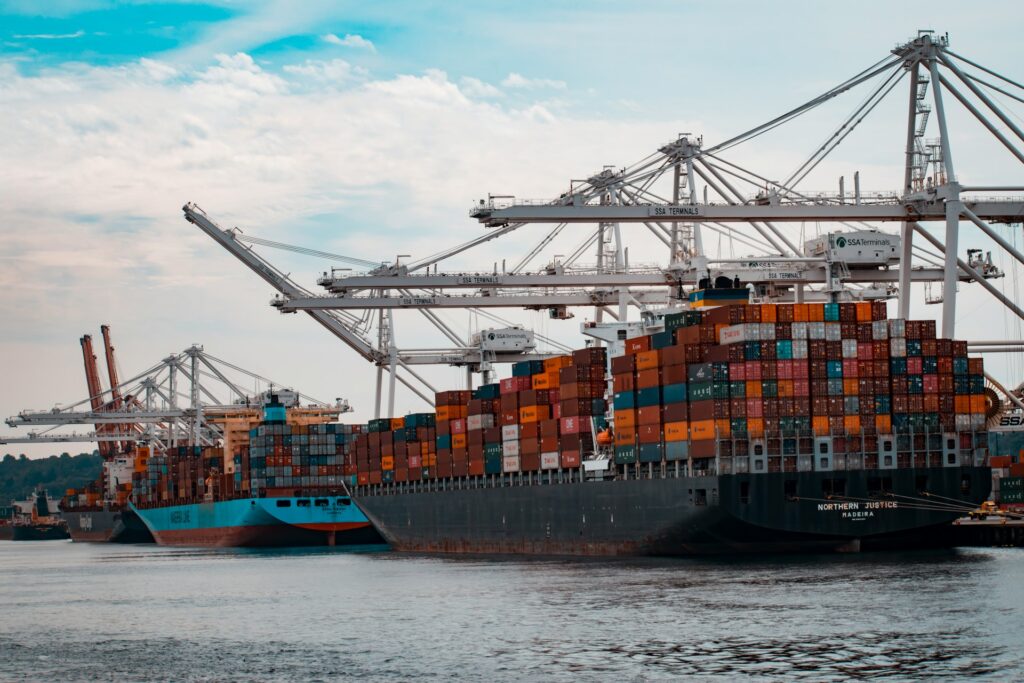
About image: Freight containers in Seattle port. Photo by Andy Li on Unsplash.
About the interviewee
Andrew Cainey is a leading advisor, educator and analyst on China, geopolitics and global business. With over 30 years’ experience advising corporations and governments, he expertly bridges policy and practice. Formerly based in Asia, Andrew now leads initiatives on UK-China relations; analyses China’s development at home and abroad and the reactions of others; and helps firms navigate the shift to a multipolar world. He is the co-author of Xiconomics: What China’s Dual Circulation Strategy Means for Global Business (2023).